Table of Contents
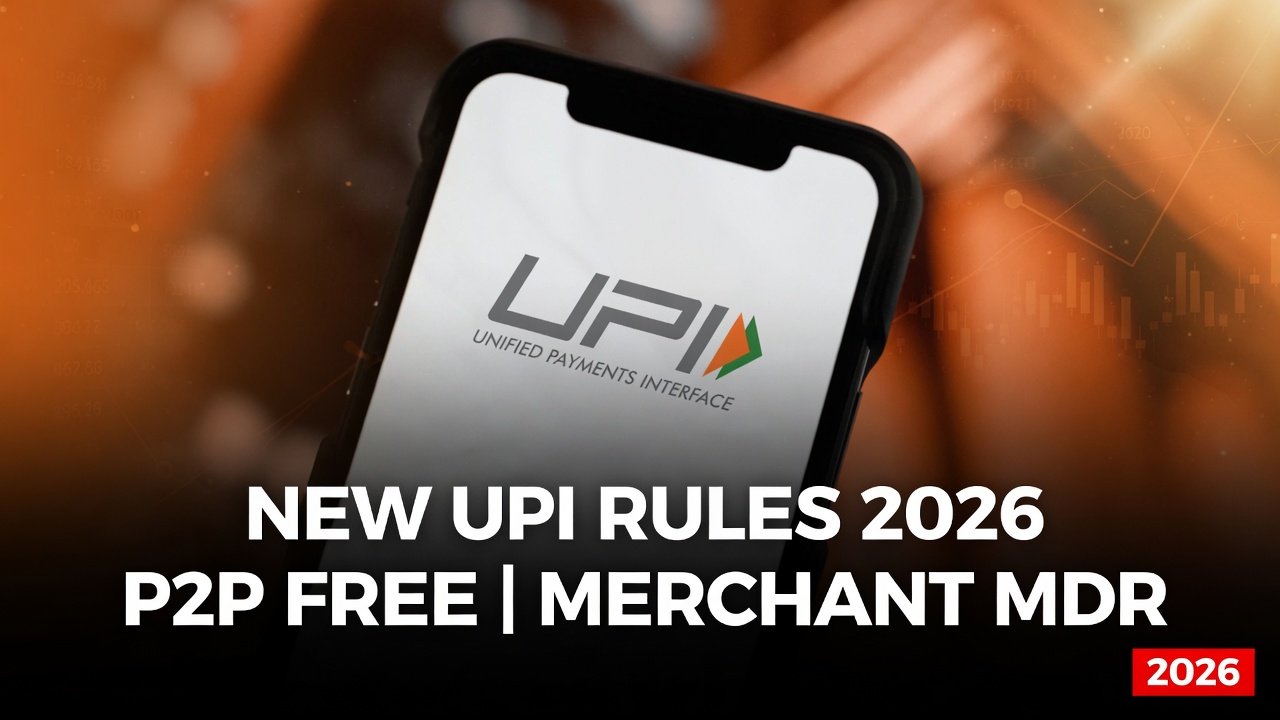
ToggleNew UPI Rules 2026: P2P Payments Remain Free, 0.4% MDR on Large Merchant Transactions
The New UPI Rules 2026 have been clarified by the government, putting an end to confusion over whether ordinary users will have to pay charges for transferring money through the Unified Payments Interface. According to the Ministry of Finance, person-to-person (P2P) UPI transactions will remain completely free, regardless of the amount transferred.
Under the revised framework, a 0.4% Merchant Discount Rate (MDR) will apply to specified person-to-merchant (P2M) transactions above ₹2,000. However, the MDR is a charge within the merchant-payment ecosystem and is not supposed to be passed on to consumers.
The new framework is scheduled to take effect from October 15, 2026, according to reports on the revised UPI MDR structure.
P2P UPI Transfers Will Remain Completely Free
One of the most important points in the government’s clarification is that there will be no MDR on person-to-person transactions.
This means users can continue sending money to friends, family members or other individuals through UPI without paying a transaction charge, irrespective of the amount.
The Finance Ministry has specifically stated that no transaction fee, platform fee or other charge may be imposed on individuals for sending or receiving money through P2P UPI transactions.
This distinction is important because recent discussions about UPI charges had created concerns that everyday digital payments could become more expensive.
UPI Payments Up to ₹2,000 to Merchants Remain Free
The new framework also protects low-value merchant payments.
UPI payments made to merchants up to ₹2,000 will remain free of MDR. The government says transactions covered under the existing zero-MDR framework for small merchants will also remain unaffected.
According to the government’s data, approximately 96% of P2M transactions will remain unaffected by the new MDR framework. MDR will apply only to specified merchant transactions above ₹2,000.
For consumers, this means that common everyday payments such as buying groceries, paying for food or making other small purchases through UPI will generally remain outside the new MDR structure when the transaction falls within the applicable threshold.
What Is the 0.4% MDR on UPI Payments?
MDR stands for Merchant Discount Rate. It is a fee associated with processing certain merchant payments and is distributed among participants in the payments ecosystem.
Under the new framework, a 0.4% MDR will apply to specified P2M UPI transactions above ₹2,000. For transactions of ₹75,000 and above, the MDR will be capped at ₹300 per transaction.
Importantly, the government has clarified that MDR is not a tax collected by the government or NPCI.
Instead, the charge is distributed among payment ecosystem participants, including banks, payment service providers and UPI application providers.
Customers Will Not Be Required to Pay MDR
Another major clarification concerns who actually bears the MDR.
The government says MDR is a charge within the merchant-payment ecosystem and is not a charge on customers making UPI payments. Banks have been advised to ensure that merchants do not pass the MDR cost on to consumers. UPI application providers are also prohibited from imposing platform fees or hidden charges in this context.
Therefore, a consumer making an eligible UPI payment above ₹2,000 should not interpret the 0.4% MDR as a separate fee that will automatically be deducted from their bank account.
The framework is designed around charges within the merchant-side payment ecosystem rather than a direct consumer transaction fee.
Special ₹5 MDR for Fuel and Railway Transactions
The government has also established a special flat MDR for certain essential and thin-margin sectors.
For specified transactions above ₹2,000 involving sectors such as railways, telecommunications, insurance, fuel and agricultural inputs, the MDR will be a flat ₹5 per transaction rather than the standard 0.4% rate.
The objective is to provide greater cost certainty for sectors where margins can be relatively narrow or where digital payments play an important role in public and essential services.
For example, an eligible fuel transaction above ₹2,000 would fall under the specified flat-rate framework rather than having the standard percentage-based MDR applied.
Small Merchants Get Continued Protection
The revised framework also includes protections for small merchants.
Small merchants receiving up to ₹1 lakh per month through UPI QR codes under the Person-to-Person-Merchant (P2PM) category will continue to receive zero MDR on their transactions.
This provision is particularly relevant for street vendors, neighbourhood stores and other small businesses that depend heavily on UPI payments.
The government’s stated objective is to prevent additional payment costs from affecting micro-businesses that rely on digital payments for everyday transactions.
Why the Government Is Introducing the New Framework
The government has linked the revised framework to the long-term sustainability and expansion of the UPI ecosystem.
UPI has grown rapidly since its launch and has become a central part of India’s digital-payment infrastructure. The government had previously said that any future MDR would be limited to selected merchant transactions and would not create charges for consumers.
The new structure attempts to maintain free access for individuals and smaller transactions while creating a revenue mechanism for certain higher-value merchant payments.
The government says the framework is intended to support the continued operation and expansion of the UPI ecosystem.
How the New UPI Rules Affect Everyday Users
For most individual users, the direct impact should remain limited.
Consider a few examples:
Sending ₹10,000 to a friend:
This is a P2P transaction and remains free.
Paying ₹1,500 to a merchant:
The payment remains outside the standard 0.4% MDR because it is within the ₹2,000 threshold.
Paying a merchant ₹5,000:
A specified 0.4% MDR applies within the merchant-payment ecosystem, but the customer is not supposed to be charged this MDR.
Eligible fuel or railway payment above ₹2,000:
The specified flat MDR is ₹5 per transaction.
The exact treatment can depend on the transaction category and applicable UPI framework.
What About Credit Card-Linked UPI Payments?
The government has also clarified that credit card-linked UPI payments are not covered by the new 0.4% MDR regime, according to recent reporting.
This is relevant because UPI payments can be funded through different instruments and payment arrangements.
The distinction between bank-account-based UPI transactions and credit-linked payments means users should not assume that every type of UPI transaction will automatically be subject to the same MDR structure.
UPI’s Growing Importance in India’s Digital Economy
The changes come at a time when UPI has become deeply integrated into India’s payments ecosystem.
Government data showed that UPI had 55.49 crore onboarded users as of June 2026, while the system processed 24,162 crore transactions during FY 2025-26, with transaction value reaching ₹314 lakh crore.
The scale of the platform means that even small changes to its pricing or operating framework can attract significant public attention.
The government’s latest clarification is therefore aimed not only at explaining the new MDR structure but also at making clear that ordinary users will continue to have access to free UPI transactions.
New UPI Rules and Merchant Payments Explained
The biggest distinction under the new framework is between P2P and P2M transactions.
P2P refers to payments between individuals, such as sending money to a family member.
P2M refers to payments made by an individual to a merchant or business.
The new MDR framework primarily targets specified P2M transactions above ₹2,000. P2P transactions remain outside the MDR framework regardless of the amount transferred.
This distinction is important because headlines suggesting that “UPI will be charged above ₹2,000” can be misleading if they do not specify that the threshold applies to certain merchant payments rather than person-to-person transfers.
Looking Ahead
The New UPI Rules 2026 introduce a more differentiated MDR structure while keeping person-to-person payments completely free.
The key changes are focused on specified merchant transactions above ₹2,000, with a standard 0.4% MDR, a ₹300 cap for transactions of ₹75,000 and above, and a flat ₹5 MDR for specified essential-sector transactions such as fuel and railways.
At the same time, payments to merchants up to ₹2,000 and eligible transactions involving small merchants remain protected under the zero-MDR framework. The government says around 96% of merchant transactions will remain unaffected.
For consumers, the central message is straightforward: sending money to another person through UPI remains free, and the new MDR is not intended to become a direct charge on everyday UPI users.
FAQs
1. Will UPI charges apply to sending money to friends and family?
No. P2P UPI transactions will remain completely free, regardless of the amount transferred.
2. What is the new UPI MDR rate?
A 0.4% MDR will apply to specified merchant transactions above ₹2,000, with a cap of ₹300 for transactions of ₹75,000 and above.
3. Will customers have to pay the 0.4% UPI charge?
No. The government has clarified that MDR is a merchant-payment ecosystem charge and should not be passed on to consumers.
4. Will UPI payments below ₹2,000 remain free?
Yes. Merchant payments up to ₹2,000 will remain free of MDR, along with transactions covered by the zero-MDR framework for small merchants.
5. What is the UPI MDR for fuel and railway payments?
Specified transactions above ₹2,000 in sectors including fuel and railways will attract a flat MDR of ₹5 per transaction.
6. When will the new UPI MDR framework take effect?
The revised framework is scheduled to come into effect on October 15, 2026.