Biomechanics in Athletics: India Expands Data-Driven Monitoring for Track-and-Field Athletes
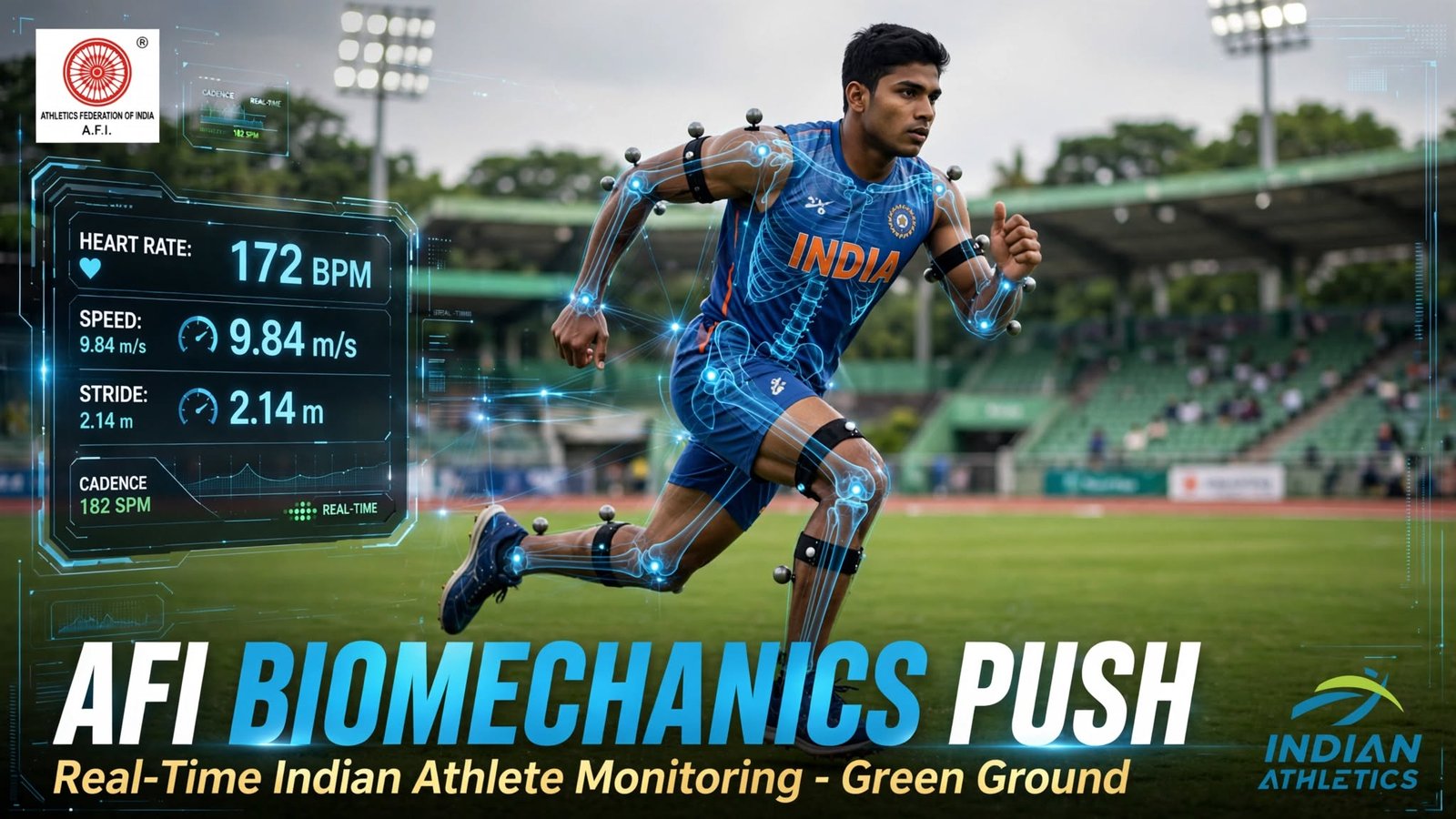
Biomechanics in Athletics is becoming an increasingly important part of India’s high-performance sports strategy as the Athletics Federation of India (AFI) and national training camps expand the use of advanced sports-science systems.
The increased deployment of real-time telemetry and biomechanics monitoring is designed to provide coaches and athletes with more detailed information about performance, movement patterns and training responses.
Technology Takes a Bigger Role in Athletics
Modern athletics increasingly relies on data to improve performance.
Traditional coaching methods remain important, but technology can provide additional information that may not be visible to the naked eye.
Sensors, motion analysis systems and telemetry can capture details about an athlete’s movement, speed, acceleration and other performance indicators.
When this information is combined with coaching expertise, it can help create a more detailed picture of an athlete’s strengths and areas for improvement.
What Is Biomechanics in Athletics?
Biomechanics involves studying how the human body moves and responds to forces during physical activity.
In track and field, this can include analysing running mechanics, stride patterns, joint movement, take-off angles, landing positions and other elements of athletic technique.
For sprinters, small changes in running mechanics can influence acceleration and maximum speed.
For jumpers and throwers, technical positioning and force production can have a major impact on performance.
Biomechanical monitoring provides coaches with measurable information that can support these technical assessments.
Real-Time Telemetry Adds Another Layer of Data
Real-time telemetry allows performance information to be collected and monitored while training is taking place.
Instead of relying exclusively on observations made after a session, coaches and sports-science teams can examine data generated during the activity.
This can potentially help identify changes in performance, workload and technique more quickly.
The approach is particularly useful when athletes are completing high-intensity training sessions where small changes in mechanics or fatigue levels may matter.
Supporting Evidence-Based Coaching
One of the biggest advantages of sports science is the ability to complement coaching decisions with objective measurements.
A coach may notice that an athlete’s technique changes late in a training session. Biomechanical and telemetry data can provide additional evidence about what is happening.
This can help teams distinguish between technical problems, fatigue-related changes and normal variations in performance.
The goal is not to replace coaches but to give them better information for decision-making.
Applications Across Track and Field
Biomechanics can be useful across multiple athletics disciplines.
For sprinters, analysis can focus on stride length, stride frequency, acceleration and running posture.
Jumpers can be assessed on their approach, take-off mechanics and landing.
Throwing events can involve analysis of body positioning, rotational movement and the sequence through which force is transferred.
Distance runners can also benefit from movement and workload analysis, particularly when managing training volume and efficiency.
This makes biomechanics relevant across a broad section of India’s track-and-field programme.
Monitoring Athlete Workloads
Another important application of sports science is workload management.
Athletes need sufficient training stimulus to improve, but excessive workload can affect recovery and performance.
Real-time monitoring can provide coaches with additional information that can be considered alongside an athlete’s training schedule and physical feedback.
This can support more individualized training decisions rather than applying exactly the same workload to every athlete.
Potential Benefits for Injury Prevention
Biomechanical analysis can also contribute to injury-management strategies.
Changes in movement patterns may sometimes indicate that an athlete is compensating for fatigue, discomfort or a developing technical issue.
Identifying such changes does not automatically predict an injury, but it can provide useful information for sports-science and medical teams.
Coaches can then consider whether training intensity, technique work or recovery should be adjusted.
National Training Camps Become Testing Grounds
National training camps provide an important environment for deploying advanced sports-science systems.
Athletes are already working under structured training programmes, making it easier for sports scientists and coaches to collect information over multiple sessions.
Repeated measurements can also help teams track progress rather than relying on a single snapshot of performance.
Over time, this can create a more comprehensive performance profile for individual athletes.
Data Can Improve Individualization
Elite athletes do not all respond to training in exactly the same way.
Two athletes competing in the same event may have different technical strengths, physical characteristics and recovery requirements.
Data-driven monitoring can help coaches understand these differences.
Instead of focusing only on general performance benchmarks, teams can examine individual movement and training patterns and develop more personalized approaches.
India’s Growing Sports-Science Ecosystem
The increased use of biomechanics and telemetry reflects the broader professionalization of Indian sport.
Sports science now covers several areas, including biomechanics, strength and conditioning, nutrition, recovery, psychology and performance analytics.
The integration of these disciplines can help create a more complete high-performance environment for elite athletes.
For athletics, where improvements can sometimes come down to very small technical margins, detailed analysis can be particularly valuable.
Technology Still Needs Human Expertise
Advanced monitoring systems can generate large amounts of information, but data alone does not guarantee better performance.
The information needs to be interpreted correctly and connected to an athlete’s training objectives.
Coaches, physiotherapists, sports scientists and medical professionals therefore continue to play a central role.
The strongest approach is likely to combine technology with practical coaching experience and direct athlete feedback.
A Shift Toward Data-Driven Athletics
The expansion of sports-science monitoring signals a broader shift in the way elite athletics is being approached.
Rather than evaluating performance only through competition results, training teams can examine the underlying mechanics and physiological demands that contribute to those results.
This could help athletes make incremental improvements while also supporting more structured training and recovery decisions.
What This Could Mean for Indian Athletes
For India’s track-and-field athletes, wider access to advanced monitoring could improve the quality of preparation for major international competitions.
Consistent data collection can help athletes and coaches understand progress over time and identify areas where additional technical work may be required.
The impact will depend on how effectively the technology is integrated into daily training and how consistently the resulting data is used.
Key Takeaway
The expansion of Biomechanics in Athletics represents a move toward more data-driven training within India’s track-and-field ecosystem.
The Athletics Federation of India and national training camps are increasing the use of sports science, real-time telemetry and biomechanics monitoring to provide coaches with deeper insights into athlete performance.
Used alongside coaching expertise, these technologies could support better technique analysis, workload management, individualized training and long-term performance development.
FAQs
1. What is biomechanics in athletics?
Biomechanics in athletics involves analysing how an athlete’s body moves and produces force during sporting activities such as running, jumping and throwing.
2. Why is biomechanics important for athletes?
It can help coaches understand movement patterns and identify technical areas that may influence athletic performance.
3. What is real-time telemetry?
Real-time telemetry involves collecting and transmitting performance information while an athlete is training or competing.
4. How can biomechanics help sprinters?
It can be used to examine factors such as stride patterns, acceleration, running posture and other aspects of sprint mechanics.
5. Can biomechanics help prevent injuries?
Biomechanical information can help identify changes in movement that may warrant closer attention, although it cannot guarantee injury prevention.
6. What role does the Athletics Federation of India play?
The Athletics Federation of India oversees Indian athletics and supports the development and preparation of athletes competing at national and international levels.
7. Why are national training camps important for sports science?
They provide a structured environment where athletes can be monitored repeatedly and performance data can be integrated with their training programmes.
8. Does technology replace coaches?
No. Technology provides additional information, while coaches and sports-science professionals interpret that information and apply it to training decisions.
9. Which athletics events can benefit from biomechanics?
Biomechanical analysis can support sprinters, distance runners, jumpers, throwers and athletes across many other track-and-field disciplines.
10. What is the broader significance of this development?
The growing use of sports science indicates that Indian athletics is moving toward increasingly data-driven and individualized approaches to elite athlete preparation.