In an effort to increase its footprint in the Asia-Pacific area, Adani Ports and SEZ Ltd, the largest private port operator in India, announced on Thursday that it will purchase a coal export terminal in Australia for $2.4 billion non-cash from a group firm.
The firm issued a statement stating that the APSEZ Board “approved the acquisition of Abbot Point Port Holdings Pte Ltd (APPH), Singapore, from Carmichael Rail and Port Singapore Holdings Pte Ltd, Singapore (CRPSHPL)”. One linked party is CRPSHPL.
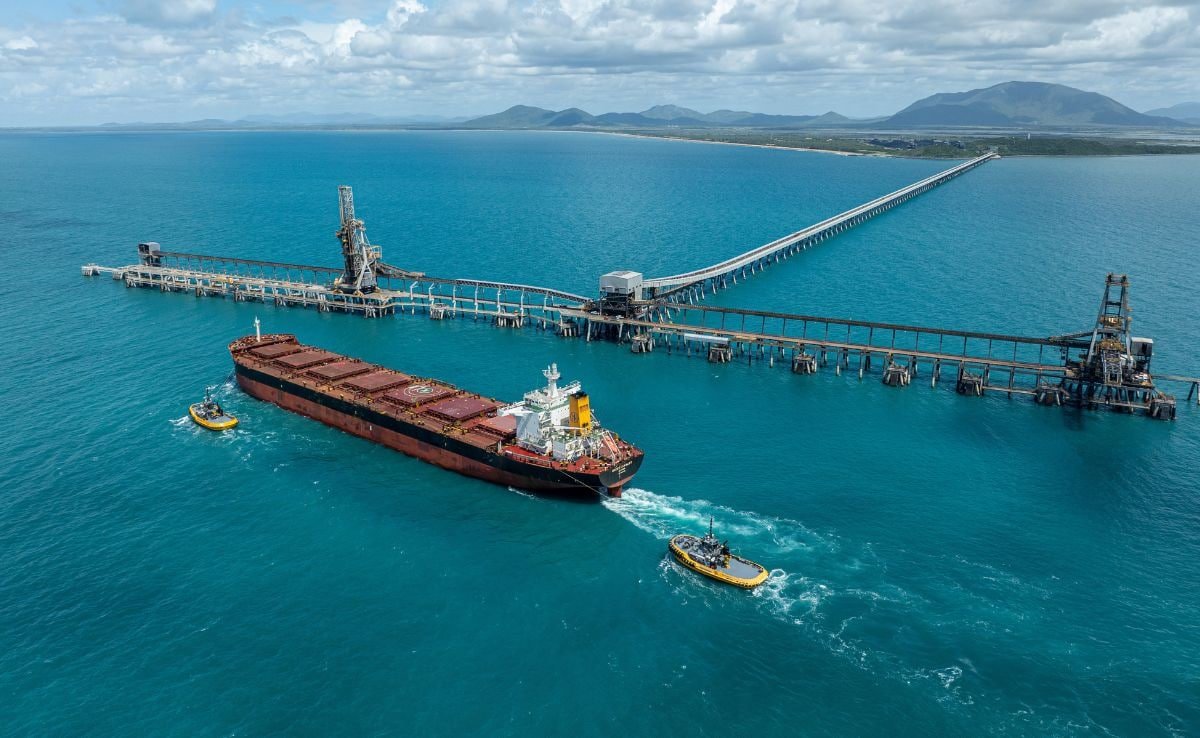
The North Queensland Export Terminal, a dedicated export terminal with a current nameplate capacity of 50 million tonnes per annum (MTPA), is owned and operated by APPH. The terminal is situated in North Queensland, on the east coast of Australia, near the Port of Abbot Point, some 25 kilometers north of Bowen.
The North Queensland Export Terminal (NQXT) in Abbott Point was first purchased by APSEZ in 2011 for $2 billion. The Adani family bought the asset and the invested cash from APSEZ for the same sum two years later, in 2013, allowing the business to focus on growing its domestic activities.
Now, with a strengthened balance sheet and a dominant position in India, APSEZ is re-acquiring the terminal as part of its global growth strategy.
“The transaction will be completed on a non-cash basis. APSEZ will issue 14.38 crore new equity shares to CRPSHPL in exchange for the acquisition of 100 per cent interest in APPH. This is based on an enterprise value of NQXT of Australian Dollar 3.975 billion (about $2.4 billion),” the statement said.
The acquisition is valued at almost similar levels to the transfer done in 2013. This valuation is despite capital investments, growth and inflation of the past 12 years and at slightly discounted multiples to the recent deals in the region.
“As part of the transaction, APSEZ will also assume other non-core assets and liabilities on APPH’s balance sheet, which APSEZ will realise within a few months of the acquisition (zero net impact on the transaction valuation). APSEZ’s leverage will remain at similar levels post the transaction,” the statement said without giving details of the liabilities.
The acquisition will accelerate the APSEZ’s target of doubling its volumes to 1 billion tonnes per annum by FY30, with a potential to near quadruple its volume – from 35 million tonnes in FY25 to 120 million tonnes, including potential exports of green hydrogen from Australia, the company said.
This is the fourth overseas acquisition for India’s largest port developer in the past two years. With this, the company will have a portfolio of 19 ports and terminals – 15 domestic and 4 overseas. A port in Israel, terminals in Tanzania and Sri Lanka are the other three international locations where APSEZ has its operations.
NQXT has a contract with Bravus Mining and Resources (formerly Adani Mining, fully owned by Adani Enterprises) for the export of 9.3 million tonnes of thermal coal from the Adani Carmichael coal mine.
The move by APSEZ comes at a time when the global ports industry is gaining strong prominence amid rising trade tensions, particularly between the US and China.
US investment giant BlackRock is reportedly seeking to acquire Panama Ports from Hong Kong-based conglomerate CK Hutchison for $23 billion but has faced resistance from Chinese stakeholders.
In January of last year, BlackRock also paid $12.5 billion to purchase Global Infrastructure Partners (GIP), a company that owns port interests throughout the world.
With a little higher valuation multiple of 18x EV/EBITDA, DP World raised its ownership in its Australian port in 2019. NQXT is being acquired by APSEZ at an almost 17x price.
“India will continue to be a priority for APSEZ. The business is extremely picky about its foreign objectives and will only get involved in areas where Indian trade routes would be important. In order to increase synergies, this acquisition will consolidate all group ports under one roof, according to a senior company executive who described APSEZ’s strategy for international expansion.
Having no direct exposure to the western region, NQXT, the deep-water terminal has 90 per cent exposure to the faster-growing Asian market, with China and India accounting for nearly half of the volumes, said a senior company source.
Based in Queensland, this deepwater port is near Bowen and Galilee mining basins and has a high-quality customer base, said the company.
On FY25 numbers, the acquisition will add 8 per cent to APSEZ’s volumes and 6.4 per cent to its EBITDA.
Even though not a part of China’s Belt and Road Initiative, Australia, one of the most resource-rich nations, has drawn nearly $9 billion in Chinese investment in its ports sector, second only to Tanzania. Australia also remains an important trading and strategic partner for India when it comes to natural resources.
Speaking on the acquisition, APSEZ CEO Ashwani Gupta said, “NQXT’s acquisition is a pivotal step in our international strategy, opening new export markets and securing long-term contracts with valued users. Strategically located on the East-West trade corridor, NQXT is poised for robust growth as a high-performing asset, driven by increased capacity, upcoming contract renewals in the medium term, and the potential for green hydrogen exports in the long term. We are targeting EBITDA growing to Australian Dollar 400 million within 4 years.”
The Port of Abbot Point (within which NQXT is located) has been declared as a strategic port and a Priority Port Development Area by the Queensland Government.
The Queensland Government has a long-term lease on NQXT, a vital piece of infrastructure that supports Australia’s sizable resource sector.
With long-term “take or pay” contracts, it offers strategic access to eight significant clients at the moment. NQXT handled an all-time high cargo volume of 35 million tonnes in FY25, while having a contract capacity of 40 million tonnes. NQXT exported its cargo to 15 nations, with 10% going to Europe and 88% going to Asia.
In FY25, NQXT reported revenue of $349 million and EBITDA of $228 million in Australian dollars.