Table of Contents
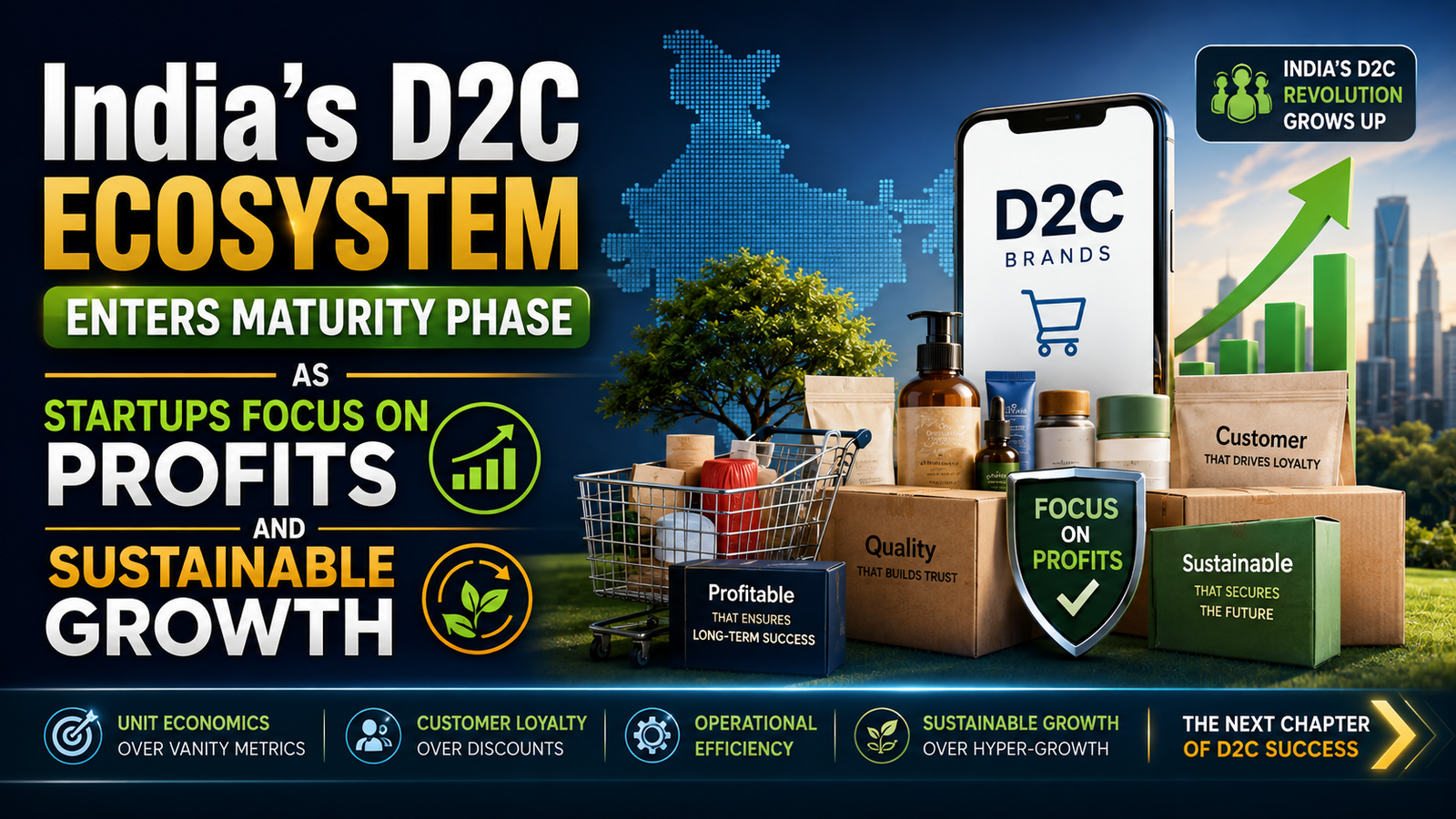
ToggleIndia D2C Ecosystem Enters Maturity Phase as Brands Shift Focus to Sustainable Growth
The India D2C ecosystem is entering a new phase of growth. A recent market report tracking India’s digital-first brands shows that the sector is moving away from the aggressive funding and spending patterns that defined its early years.
Instead, D2C companies are increasingly focusing on sustainable unit economics, controlled expansion and long-term profitability.
The change is also visible in the way investors are deploying capital. Seed and early-stage investments now account for more than 70% of total funding, while successful brands are increasingly looking towards IPOs and strategic acquisitions as their preferred exit routes.
This marks an important transition for India’s consumer startup landscape.
India D2C Ecosystem Moves Beyond the Cash-Burning Era
The early D2C boom was driven by a simple idea: build a brand quickly, acquire customers aggressively and use venture capital to finance rapid expansion.
Companies spent heavily on digital advertising, discounts, influencer marketing and customer acquisition.
For a while, growth was often treated as the most important metric.
But the startup funding environment has changed significantly.
Investors are now paying much closer attention to margins, repeat purchases, customer acquisition costs and overall profitability.
As a result, D2C companies are being pushed to prove that their businesses can generate sustainable returns rather than simply grow revenue through continuous external funding.
Sustainable Unit Economics Are Taking Centre Stage
One of the biggest changes in the India D2C ecosystem is the increasing importance of unit economics.
Unit economics essentially looks at how much a company earns from an individual customer or transaction compared with the costs involved in acquiring and serving that customer.
For a D2C brand, factors such as product margins, shipping costs, marketing expenses, repeat purchases and customer retention can make a major difference.
A company that can attract customers profitably has a stronger foundation than one that depends heavily on discounts and expensive advertising.
This shift is forcing founders to become more disciplined about growth.
Seed and Early-Stage Funding Dominates
According to the market trends highlighted in the report, seed and early-stage funding now account for more than 70% of total D2C investments.
This is an interesting development because it suggests that investors continue to see opportunities in India’s consumer market, but they may be more selective about where they deploy larger amounts of capital.
Rather than putting huge sums into already established brands purely for growth, investors are increasingly looking for businesses with strong products, clear customer demand and the potential to build sustainable economics.
For young founders, this could mean that demonstrating product-market fit has become more important than simply showing rapid top-line growth.
Why Investors Are Still Interested in D2C
India remains an attractive consumer market.
The country’s large population, rising digital adoption and growing online shopping base continue to create opportunities for new consumer brands.
D2C businesses can also build direct relationships with customers without relying entirely on traditional retail distribution.
This gives brands access to customer data and allows them to test products and marketing strategies relatively quickly.
However, the easy-growth phase is over.
Investors now want to know whether those advantages can translate into durable businesses.
The Rise of Profitable Consumer Brands
The current phase of the D2C market is likely to favour companies that have developed strong fundamentals.
Brands with high repeat purchase rates, healthy gross margins and efficient customer acquisition can potentially survive even when funding becomes tighter.
This creates a natural divide within the sector.
Some startups may struggle because their growth depended heavily on discounts and advertising expenditure.
Others may emerge stronger because they have already built loyal customer communities and efficient supply chains.
The result could be a more mature D2C ecosystem with fewer companies chasing growth at any cost.
IPOs Are Becoming Important Exit Routes
Another major trend highlighted by the report is the growing importance of IPOs as an exit route for D2C companies.
A public listing can provide early investors and founders with liquidity while giving the company access to public-market capital.
For mature consumer brands, an IPO can also provide greater visibility and credibility.
The increasing focus on public markets suggests that some D2C companies have moved beyond the traditional startup phase and are now thinking about becoming long-term public businesses.
Strategic Acquisitions Are Gaining Momentum
Acquisitions are another increasingly important exit route.
Large consumer and retail companies can use acquisitions to gain access to emerging brands, new customer segments and digital distribution channels.
Companies such as HUL and Reliance have shown interest in the broader consumer and digital-first brand ecosystem.
For large corporations, acquiring a successful D2C brand can sometimes be faster than building a new brand from scratch.
For startup founders and investors, an acquisition can provide an attractive exit while allowing the brand to scale with the resources of a larger company.
Why HUL and Reliance Are Watching D2C Brands
Traditional consumer companies have spent decades building distribution networks and physical retail presence.
D2C brands, meanwhile, have developed strong digital relationships with younger consumers.
This creates a natural strategic fit.
A large consumer company can provide manufacturing capacity, distribution and retail reach.
The D2C brand can bring digital marketing expertise, a distinct identity and an existing online customer base.
That combination can make acquisitions attractive for established businesses looking to adapt to changing consumer behaviour.
Reliance and the Changing Consumer Market
Reliance has built a significant presence across India’s retail and consumer ecosystem.
Its scale provides access to physical stores, digital commerce and a large customer base.
For emerging D2C brands, joining a large corporate ecosystem can provide resources that would otherwise take years to build.
This is one reason strategic acquisitions are becoming increasingly important in India’s consumer startup landscape.
The D2C Model Is Evolving
The meaning of D2C itself is also changing.
Initially, the model was largely associated with brands selling products directly to customers through their own websites and social media.
Today, successful D2C brands often operate across multiple channels.
They may sell through their own websites, marketplaces, quick-commerce platforms, modern retail stores and traditional distribution networks.
This hybrid approach can help brands reach more consumers while reducing dependence on a single sales channel.
Omnichannel Could Be the Next Growth Engine
The strongest D2C companies may increasingly become omnichannel businesses.
Online channels are useful for customer acquisition, brand building and direct engagement.
Physical retail, meanwhile, can help consumers discover products and build trust, particularly in categories such as beauty, personal care, food and lifestyle.
Combining both approaches can create a stronger distribution network.
For investors, the ability to scale across channels could become an important indicator of a D2C company’s long-term potential.
What This Means for New D2C Founders
The changing funding environment does not mean that opportunities are disappearing.
Instead, the expectations are changing.
Founders may need to focus more closely on:
- Healthy gross margins
- Customer retention
- Repeat purchases
- Efficient customer acquisition
- Inventory management
- Strong supply chains
- Sustainable cash flows
A good product alone may not be enough.
The ability to build a financially sustainable business is becoming increasingly important.
D2C Funding Is Becoming More Selective
The shift towards early-stage funding does not necessarily mean investors have lost interest in the sector.
It suggests that capital is being deployed differently.
Investors may be more willing to support promising young brands while becoming more cautious about putting large amounts of money into businesses that have not demonstrated strong economics.
This could ultimately improve the quality of the overall ecosystem.
Startups that survive this more disciplined environment may have stronger foundations.
The Consumer Opportunity Remains Huge
India’s consumer market continues to offer significant opportunities for entrepreneurs.
Consumers are increasingly discovering products through social media, creators, online communities and digital marketplaces.
This gives smaller brands the ability to reach customers without immediately building nationwide physical distribution.
At the same time, India’s growing middle class and expanding digital economy create room for specialised brands targeting specific consumer segments.
The challenge is no longer simply finding customers.
It is retaining them profitably.
What the Maturity Phase Could Look Like
A mature India D2C ecosystem could look very different from the market seen during the funding boom.
There may be fewer companies raising extremely large rounds purely to expand rapidly.
Instead, businesses may grow at a more measured pace while focusing on profitability and operational efficiency.
Successful brands could increasingly become acquisition targets or prepare for public listings.
This would represent a natural evolution from startup experimentation to established consumer businesses.
A New Chapter for India’s D2C Market
The D2C sector is not slowing down so much as growing up.
The focus is shifting from “How fast can we grow?” to “Can we build a business that lasts?”
That change is visible in funding patterns, investor expectations and the growing importance of IPOs and strategic acquisitions.
For founders, this environment may be more challenging than the funding boom years.
But for the strongest businesses, it could also create an opportunity to build brands with genuinely durable value.
The India D2C ecosystem is entering a more disciplined phase, and the companies that can combine strong consumer demand with healthy economics are likely to be the ones that define its next chapter.
Frequently Asked Questions (FAQs)
1. What is the India D2C ecosystem?
The India D2C ecosystem refers to the growing network of direct-to-consumer brands, startups, investors, technology platforms and businesses that sell products directly to customers through digital and increasingly omnichannel channels.
2. Is D2C funding in India slowing down?
The funding environment has become more selective. Investors are increasingly focused on sustainable business models, unit economics and long-term profitability rather than funding growth at any cost.
3. What percentage of D2C investments are seed and early-stage funding?
The market report highlighted that seed and early-stage investments account for more than 70% of total D2C investments.
4. Why are unit economics important for D2C brands?
Unit economics helps determine whether a company can make money from individual customers or transactions after considering costs such as marketing, product manufacturing, shipping and customer acquisition.
5. Are D2C companies moving towards IPOs?
Yes. IPOs are increasingly becoming an important exit route for mature D2C brands that have reached sufficient scale and financial maturity.
6. Why are companies like HUL interested in D2C brands?
Large consumer companies can use D2C acquisitions to gain access to emerging brands, younger consumers, digital capabilities and new product categories.
7. Why is Reliance interested in consumer brands?
Reliance has a large retail and digital ecosystem, making emerging consumer brands strategically attractive for expanding its presence across different categories and customer segments.
8. Is the D2C business model still attractive in India?
Yes. India’s large consumer market and growing digital adoption continue to create opportunities. However, brands increasingly need strong margins, customer retention and sustainable growth to succeed.
9. What is the biggest change in India’s D2C market?
The biggest change is the shift from aggressive, cash-driven expansion towards sustainable unit economics, profitability and disciplined growth.
10. What will determine the future of India’s D2C ecosystem?
Strong products, customer loyalty, efficient acquisition, healthy margins, omnichannel distribution and the ability to build sustainable businesses will likely determine which D2C brands become long-term winners.