Table of Contents
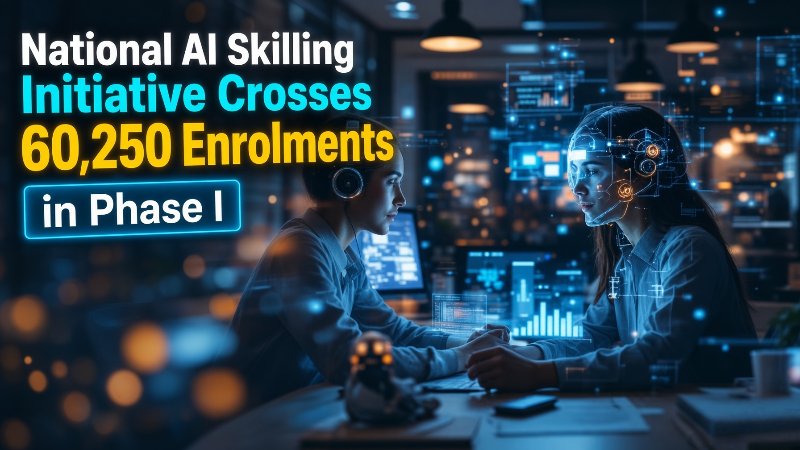
ToggleNational AI Skilling Initiative Crosses 60,250 Enrolments in Phase I
India’s push to build an AI-ready workforce has reached an important milestone, with the National AI Skilling Initiative recording more than 60,250 enrolments during Phase I.
The initiative is designed to address the growing demand for skilled technology professionals as artificial intelligence becomes increasingly important across businesses and industries.
The programme focuses on practical, industry-relevant skills in areas such as generative AI, prompt engineering and workflow automation.
Phase I Records More Than 60,250 Enrolments
The first phase of the National AI Skilling Initiative has attracted more than 60,250 enrolments, highlighting the growing interest in artificial intelligence skills among students and professionals.
The strong participation comes at a time when companies across sectors are increasing their investments in AI-powered tools and solutions.
As businesses adopt generative AI for tasks ranging from content creation and data analysis to customer support and workflow management, the demand for people who can effectively use these technologies is increasing.
Focus on Practical AI Skills
A key feature of the initiative is its focus on hands-on and practical AI training rather than only theoretical concepts.
The curriculum covers technologies and skills that participants can potentially apply in real workplace environments.
Some of the major areas include:
- Generative AI
- Prompt engineering
- AI-powered workflow automation
- Practical use of AI tools
- Industry-oriented AI applications
This approach is intended to help learners understand not only how AI works but also how it can be used to solve real business problems.
IICT and Private Sector Partners Develop Curriculum
The initiative brings together IICT and private-sector partners to develop training content aligned with the changing requirements of the technology industry.
Collaboration between government-linked institutions and industry partners can help ensure that the curriculum remains relevant to the skills companies actually require.
This is particularly important in AI, where technologies and workplace applications are evolving rapidly.
A curriculum developed with industry participation can help reduce the gap between academic learning and practical workplace requirements.
Generative AI Becomes a Core Skill
Generative AI has become one of the most important areas covered by the initiative.
Tools based on generative AI are increasingly being used by businesses for writing, coding, research, customer service, marketing, data analysis and other tasks.
However, effective use of these tools requires more than simply knowing how to interact with an AI chatbot.
Professionals need to understand how to structure prompts, evaluate AI-generated information and integrate AI into existing workflows.
Importance of Prompt Engineering
Prompt engineering is another important component of the training programme.
Well-designed prompts can help users get more useful and reliable outputs from generative AI systems.
Learning prompt engineering can therefore improve productivity and help employees use AI tools more effectively in professional environments.
The skill is becoming increasingly relevant as organisations move from experimenting with AI to incorporating it into everyday business processes.
Workflow Automation Can Improve Productivity
The initiative also focuses on workflow automation, an area that could have a significant impact on enterprise productivity.
AI-powered automation can help businesses reduce repetitive manual tasks and streamline processes.
For example, organisations can use automation for document processing, customer support, internal reporting, data handling and other routine activities.
Training workers to understand these applications can help companies make better use of their existing technology investments.
Addressing India’s AI Talent Gap
One of the major objectives of AI skilling programmes is to address the shortage of professionals with practical AI capabilities.
The rapid development of artificial intelligence has created a gap between the technologies available to businesses and the number of workers who know how to use them effectively.
Traditional technology skills are still important, but employees increasingly need additional capabilities related to AI tools, automation and data-driven decision-making.
Building this talent pool could become an important factor in India’s digital economy.
AI Skills Important for Future Workforce
AI is expected to influence a wide range of jobs rather than remain limited to specialised technology roles.
Marketing professionals, financial analysts, software developers, designers, researchers, customer-service teams and operations professionals can all potentially benefit from AI skills.
This makes AI literacy increasingly important for the broader workforce.
The National AI Skilling Initiative’s focus on practical applications could help students and professionals prepare for this changing employment landscape.
Supporting AI Adoption in Indian Enterprises
A larger pool of AI-skilled professionals could also make it easier for Indian companies to adopt artificial intelligence.
Businesses often face challenges when implementing AI because they lack employees who can identify suitable use cases, select appropriate tools and integrate them into existing processes.
Trained professionals can help organisations move from experimentation to practical implementation.
This could ultimately improve productivity and accelerate AI adoption across Indian enterprises.
Why Industry Collaboration Matters
Technology training programmes can become outdated quickly when they are developed without regular industry input.
The involvement of private-sector partners can help ensure that learners are exposed to current tools, technologies and business use cases.
This industry-academia collaboration can also help companies identify and develop talent that is better aligned with their future workforce requirements.
What Happens Next?
The next phase of the initiative will likely focus on expanding participation and strengthening the depth of AI training available to learners.
As more students and professionals gain practical experience with generative AI and automation, the programme could contribute to building a larger pool of AI-ready talent.
The success of the initiative will ultimately depend not only on enrolment numbers but also on how effectively participants apply these skills in education, employment and business environments.
Final Thoughts
The National AI Skilling Initiative crossing 60,250 enrolments in Phase I marks an important step in India’s effort to build an AI-ready workforce.
By focusing on generative AI, prompt engineering and workflow automation, the programme aims to provide learners with practical skills that can be applied in real-world business environments.
The collaboration between IICT and private-sector partners further strengthens the industry relevance of the curriculum.
As Indian enterprises accelerate their AI adoption, initiatives that build practical AI capabilities could play an important role in reducing the talent gap and preparing India’s workforce for the next phase of digital transformation.
Frequently Asked Questions
How many enrolments has the National AI Skilling Initiative recorded?
The initiative has recorded more than 60,250 enrolments in Phase I.
What is the National AI Skilling Initiative?
It is an AI-focused skilling programme designed to help students and professionals develop practical capabilities required for an increasingly AI-driven workforce.
What skills are covered in the programme?
The curriculum focuses on areas including generative AI, prompt engineering and workflow automation, along with practical industry applications.
Who developed the AI skilling curriculum?
IICT and private-sector partners have collaborated to develop the industry-focused curriculum.
Why is AI skilling important for India?
The rapid adoption of AI is creating demand for professionals who can use AI tools effectively. AI skilling can help address the talent gap and prepare workers for changing job requirements.
How can AI skills help businesses?
AI skills can help employees identify practical AI use cases, automate repetitive workflows, improve productivity and support the implementation of AI across different business functions.
What is prompt engineering?
Prompt engineering involves designing effective instructions for generative AI systems to produce more useful, relevant and accurate outputs.
Can AI training help Indian enterprises adopt AI faster?
Yes. A larger pool of professionals with practical AI knowledge can help businesses identify use cases, implement AI tools and integrate automation into everyday workflows.