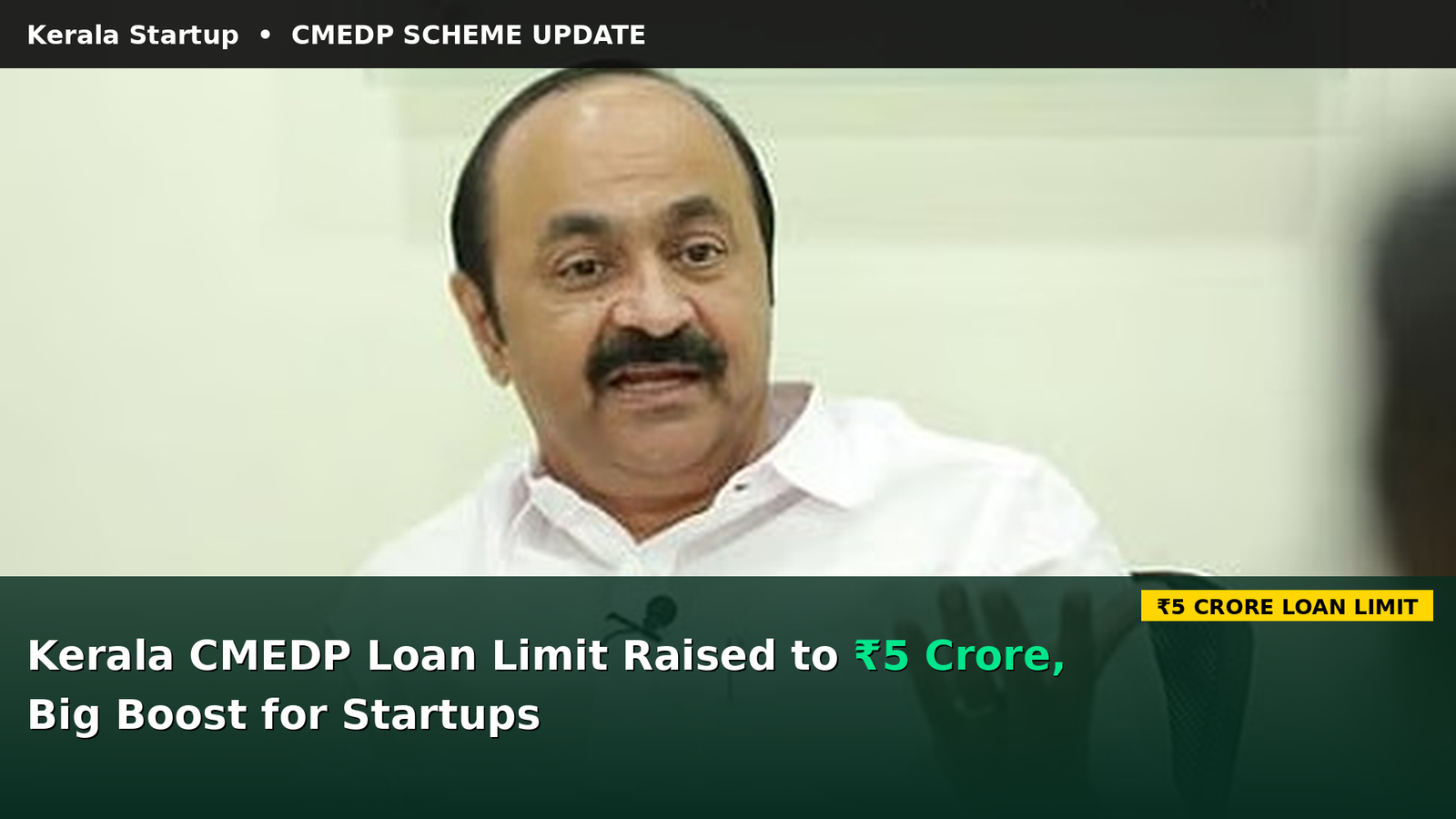
India’s startup ecosystem is expanding far beyond Bengaluru, Delhi, and Mumbai. State governments are increasingly introducing their own funding programmes to encourage entrepreneurs to build businesses locally. In a major step, the Kerala government has revamped the Chief Minister’s Entrepreneurship Development Programme (CMEDP) by increasing the maximum loan limit for entrepreneurs from ₹2 crore to ₹5 crore. Eligible businesses can also access these loans at an attractive 6% interest rate, making it one of the most entrepreneur-friendly funding initiatives introduced by a state government.
The move highlights a growing trend across India where states are competing to attract founders, generate employment, and build regional innovation hubs through affordable financing.
What Is Kerala CMEDP?
The Chief Minister’s Entrepreneurship Development Programme (CMEDP) is a Kerala government initiative aimed at supporting entrepreneurs by providing easy access to business loans.
Under the revamped programme:
- Maximum loan amount increased from ₹2 crore to ₹5 crore
- Interest rate fixed at 6%
- Improved financial support for startups and expanding businesses
- Focus on promoting entrepreneurship within Kerala
The higher funding limit is expected to help businesses scale faster without depending entirely on venture capital or private investors.
Why Affordable Startup Loans Matter
Funding remains one of the biggest obstacles for startups, especially during their early growth stages.
While venture capital is suitable for high-growth technology companies, many founders prefer debt financing because it allows them to retain ownership of their businesses.
Low-interest government loans help entrepreneurs:
- Expand operations
- Invest in technology
- Purchase equipment
- Hire employees
- Improve working capital
- Launch new products
Unlike equity funding, founders do not have to dilute their ownership while raising capital.
State Governments Are Becoming Startup Growth Partners
India’s startup ecosystem is becoming increasingly decentralized.
Instead of relying only on central government initiatives, several state governments are creating startup-friendly policies through:
- Low-interest loan schemes
- Startup incubation centres
- Innovation parks
- Business mentorship programmes
- Skill development initiatives
- Investment support
This healthy competition among states is creating more opportunities for entrepreneurs across the country.
Building Innovation Beyond Metro Cities
For years, India’s startup success stories were concentrated in Bengaluru, Delhi NCR, Hyderabad, and Mumbai.
Today, states are investing heavily in regional startup ecosystems to encourage entrepreneurs to build businesses closer to their hometowns.
Strong regional ecosystems can deliver several benefits:
- More local employment
- Better utilization of regional talent
- Increased private investment
- Stronger local industries
- Balanced economic growth
This approach also reduces the need for entrepreneurs to relocate to metropolitan cities simply to access funding or support.
Why Debt Capital Is Becoming More Attractive
Many startup founders are now considering debt financing alongside equity investment.
Government-backed loans provide:
- Lower borrowing costs
- Predictable repayment schedules
- No equity dilution
- Greater financial flexibility
- Better control over business decisions
For businesses with stable revenue models, affordable debt can often be a more efficient source of growth capital than raising venture funding.
Kerala’s Strategy Reflects a Larger National Trend
The revised CMEDP is part of a broader transformation in India’s innovation economy.
States increasingly recognize that supporting startups can:
- Create high-quality jobs
- Encourage local manufacturing
- Promote technology adoption
- Strengthen MSMEs
- Attract private investment
As more regional governments introduce similar programmes, entrepreneurs may have greater flexibility in choosing where to build and scale their businesses.
What This Means for India’s Startup Ecosystem
State-led funding initiatives are gradually changing how startups access capital.
Instead of depending only on investors located in major metropolitan cities, founders can increasingly rely on regional financial support to launch and expand their ventures.
If implemented effectively, such programmes could reduce regional economic disparities while encouraging innovation across smaller cities and emerging business hubs.
Final Thoughts
The revamped Kerala CMEDP demonstrates how state governments are taking a more active role in strengthening India’s startup ecosystem. By increasing the maximum entrepreneur loan limit to ₹5 crore and offering financing at a 6% interest rate, Kerala is providing founders with affordable growth capital while helping them retain ownership of their businesses.
As India’s innovation economy continues to evolve, regional funding programmes like CMEDP could play a crucial role in developing the next generation of successful startups outside traditional metropolitan centres. The future of Indian entrepreneurship may increasingly be shaped not just by venture capital, but by proactive state governments investing in local innovation.
FAQ
What is Kerala CMEDP?
The Chief Minister’s Entrepreneurship Development Programme (CMEDP) is a Kerala government scheme that provides financial assistance to entrepreneurs through business loans.
What is the new loan limit under CMEDP?
The revised scheme increases the maximum loan amount from ₹2 crore to ₹5 crore.
What interest rate is offered under the scheme?
Eligible entrepreneurs can avail loans at an interest rate of 6%.
Why are state governments launching startup funding schemes?
States aim to promote entrepreneurship, create jobs, retain skilled talent, and develop regional innovation ecosystems.
Why do startups prefer government-backed loans?
Government loans generally offer lower interest rates, predictable repayment terms, and allow founders to retain full ownership without giving up equity.