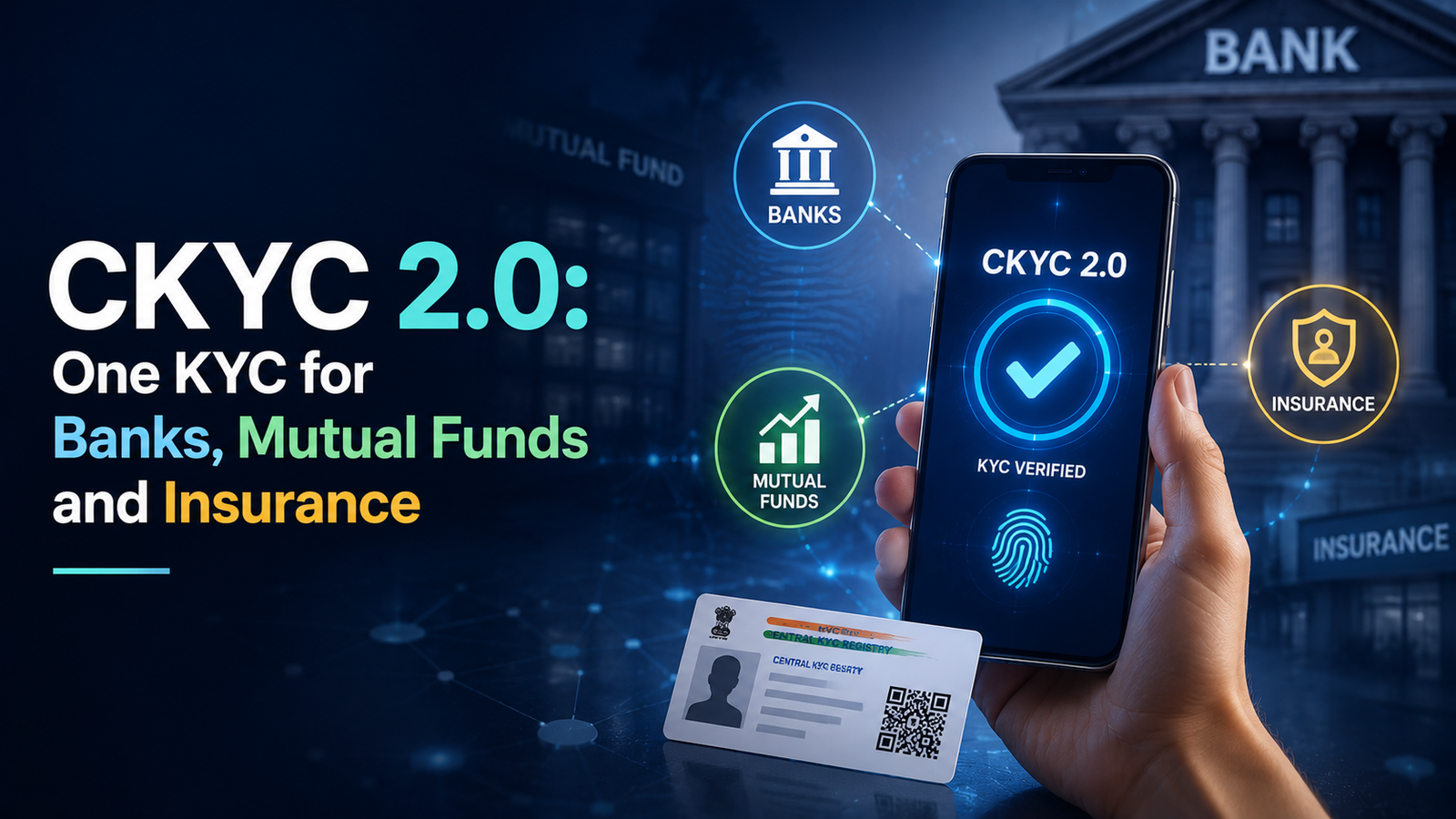
India’s financial ecosystem has taken another major step toward digital transformation with the rollout of CKYC 2.0 in August 2026. The upgraded Central Know Your Customer (CKYC) framework allows individuals to complete their KYC verification once and, with their consent, reuse the same verified records across banks, mutual funds, insurance companies, and other regulated financial institutions.
For millions of retail investors, this means fewer forms, faster account opening, and significantly less repetitive paperwork. For financial institutions, it promises lower onboarding costs, quicker customer verification, and a more efficient compliance process.
What Is CKYC 2.0?
CKYC 2.0 is the upgraded version of India’s Central Know Your Customer system, which stores verified KYC records in a centralized repository.
Instead of submitting identity and address documents separately to every financial institution, customers can authorize institutions to access their existing CKYC records.
The framework aims to create a seamless, paperless, and consent-based KYC experience across the financial sector.
How Does CKYC 2.0 Work?
The new system follows a simple process:
- A customer completes KYC verification once.
- The verified information is securely stored in the Central KYC repository.
- When opening an account with another regulated financial institution, the customer provides consent.
- The institution retrieves the verified KYC details digitally.
- There is no need to repeatedly submit the same identity documents, unless updates are required.
This significantly reduces duplication while maintaining regulatory compliance.
What’s New in CKYC 2.0?
Compared with the earlier framework, CKYC 2.0 introduces a more efficient and customer-friendly approach.
Key improvements include:
- Consent-based sharing of KYC records
- Faster digital verification
- Reduced paperwork
- Improved interoperability across financial institutions
- Quicker onboarding for customers
- Better data management and verification efficiency
The focus is on making customer onboarding smoother without compromising security.
How Does CKYC 2.0 Benefit Retail Investors?
No More Repeated KYC
Customers no longer need to upload the same PAN card, Aadhaar, address proof, and photographs every time they open a new financial account.
Faster Account Opening
Banks, mutual funds, insurers, and other financial service providers can verify customers more quickly, reducing processing time.
Better Customer Experience
The onboarding process becomes simpler, especially for investors managing multiple financial products.
Improved Digital Convenience
A centralized KYC system supports a more seamless digital financial ecosystem.
Benefits for Banks and Financial Institutions
The advantages extend beyond customers.
Lower Onboarding Costs
Digital retrieval of verified KYC records reduces document collection, manual verification, and operational expenses.
Faster Customer Acquisition
Institutions can onboard new customers more efficiently, improving conversion rates and customer satisfaction.
Better Regulatory Compliance
Using verified centralized records helps institutions maintain consistent KYC standards while reducing duplication.
Improved Operational Efficiency
Automation reduces manual paperwork and allows compliance teams to focus on higher-value activities.
Why Is This Important for India’s Financial Sector?
India has witnessed rapid growth in:
- Digital banking
- Online investing
- Mutual fund participation
- Digital insurance
- Fintech platforms
As more people access financial services online, traditional paper-based KYC processes have become a bottleneck.
CKYC 2.0 addresses this challenge by creating a unified digital identity verification framework that supports faster and more efficient financial services.
How Does CKYC 2.0 Support Ease of Doing Business?
The upgraded framework aligns with India’s broader digital governance initiatives.
It contributes to:
- Faster financial transactions
- Reduced administrative burden
- Lower compliance costs
- Improved customer experience
- Greater digital adoption
- More efficient financial infrastructure
For businesses, simplified onboarding can improve productivity while reducing operational overhead.
Is Customer Data Safe?
CKYC 2.0 is designed around regulated access and customer consent.
Financial institutions can access KYC records only through authorized processes and in accordance with applicable regulatory requirements.
Customers remain in control of how their verified information is shared within the regulated financial ecosystem.
Will Paperwork Disappear Completely?
Not entirely.
While CKYC 2.0 significantly reduces repeated document submissions, certain situations may still require fresh documentation, such as:
- Changes in address
- Updated identity documents
- Regulatory requirements
- Periodic KYC updates
However, for routine account openings, the overall paperwork is expected to reduce substantially.
What Does This Mean for the Future?
CKYC 2.0 lays the foundation for a more connected financial ecosystem.
As more regulated institutions adopt the framework, customers can expect:
- Faster digital onboarding
- Reduced paperwork
- Better interoperability
- Lower processing times
- Improved financial inclusion
The initiative also supports India’s vision of building a fully digital financial infrastructure.
Final Thoughts
The launch of CKYC 2.0 marks a significant improvement in India’s financial services ecosystem. By allowing customers to complete KYC once and securely reuse verified records across banks, mutual funds, and insurance companies, the framework removes one of the biggest frustrations faced by retail investors.
For financial institutions, lower onboarding costs and faster verification improve operational efficiency. For customers, the benefits are even more visible: quicker account opening, less paperwork, and a smoother digital experience. As adoption expands, CKYC 2.0 is expected to become an important building block in India’s digital financial infrastructure.
FAQ
What is CKYC 2.0?
CKYC 2.0 is an upgraded Central Know Your Customer framework that allows customers to complete KYC once and reuse verified records across multiple regulated financial institutions.
Which financial institutions can use CKYC 2.0?
The framework is designed for banks, mutual funds, insurance companies, and other regulated financial service providers participating in the Central KYC ecosystem.
Do customers still need to submit documents every time?
In most cases, no. With customer consent, institutions can retrieve verified KYC records digitally, reducing repeated paperwork.
Is CKYC 2.0 secure?
Yes. The framework uses regulated, consent-based access to verified KYC records while following applicable compliance and security standards.
How does CKYC 2.0 benefit investors?
It speeds up account opening, reduces paperwork, simplifies onboarding, and improves the overall digital investment experience.